

One of the most common pieces of feedback teachers give on assessments are “Answer the question” or “Unpack the key words.”
But theres a big problem: What does it mean!!
You might read the question, know the text well, and still struggle to make your essay feel like it’s actually addressing what’s being asked. Or you might panic, and just chuck in your essay and pretend the question doesn’t exist.
This guide will walk you through exactly how to do it, with a real example from Macbeth. By the end, you’ll know how to break a question apart, plan strong paragraphs, and write a thesis that ticks every box.
Lets get started!
The very first thing you should do when you get a question is highlight or underline the most important words. There are usually two types of key words:
1) The NESA directive term: This is the “action word” in the question. Examples are assess, explain, to what extent, evaluate, discuss, and analyse.
Each one tells you how to answer:
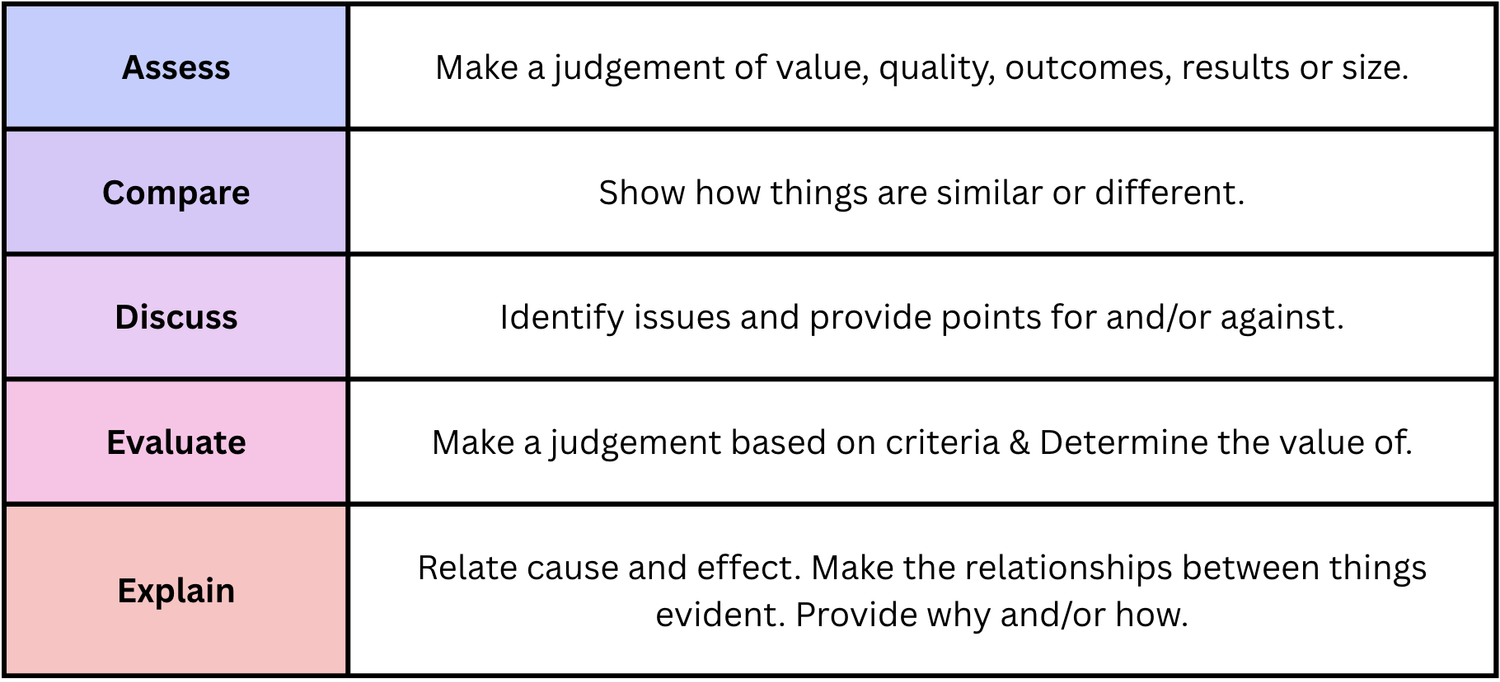
Here are the 5 key NESA Glossary terms for English
2) The content words : These tell you the topic you’re writing about. Sometimes they are broad and need to be made more specific. For example, if the question says human experience, you could narrow it to “the tension between individual and collective experiences” or “the human experience of hysteria.”
If you don’t understand the directive term, your essay will go off-track. If you don’t specify the content words, your essay will feel vague and generic.
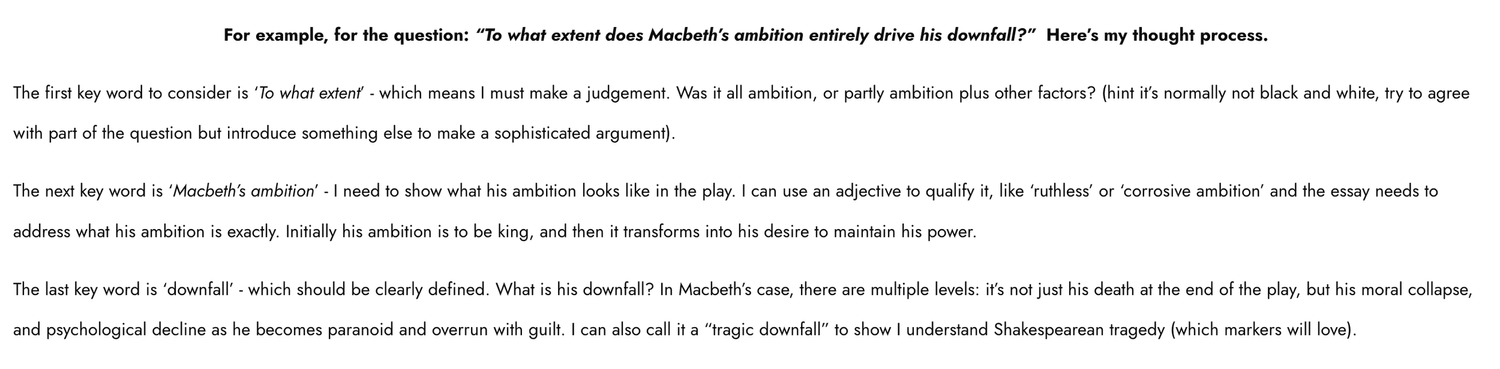
Once you understand the question, think of three different but connected points you can make about it. Each one should form the basis of a body paragraph.
Think of it like building a staircase - each paragraph is a step that takes the reader closer to your final argument.
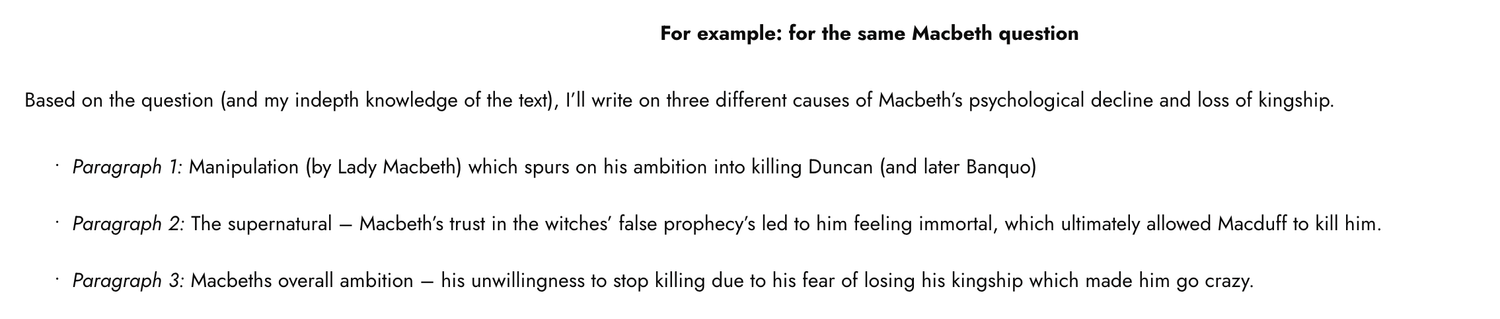
Once you’ve settled on the three main ideas you’ll develop in your body paragraphs, take a step back and ask yourself: What’s the big idea that ties all of these points together? That central insight becomes your thesis statement: the sentence or two in your introduction that clearly expresses the overall argument your essay will prove. Your thesis should not simply state a topic; it should make a an arguable claim.
A strong thesis statement does three important things:
The reader should be able to anticipate the direction of your argument and understand how your paragraphs will work together to prove your claim.

This is where a lot of essays fall flat. A statement like “Macbeth’s ambition caused his downfall” is fine, but it’s not an argument — it’s just telling the reader what happened.
Instead, you want to show how one thing leads to another. This is called cause and effect.
Notice how the strong thesis actually explains the link between the witches and his downfall. It’s more persuasive and shows deeper thinking.
Our thesis should make a claim someone could reasonably disagree with: that’s what makes it meaningful to argue in an essay.

We’ve got an incredible team of English tutors at Pinnacle Learners!
If you’re struggling to understand how to answer the question, we’ll help you strengthen your essay writing and build the confidence to ace your next assessment.
Our one-on-one lessons are available online or in person at our office in Rozelle, giving students across Sydney’s Inner West (Balmain, Leichhardt and beyond) the support they need to excel.
Over the years, our students have boosted their results by 20% or more through expert guidance, proven strategies, and mentoring that goes beyond the textbook.