24 Key Words for Studying 1984
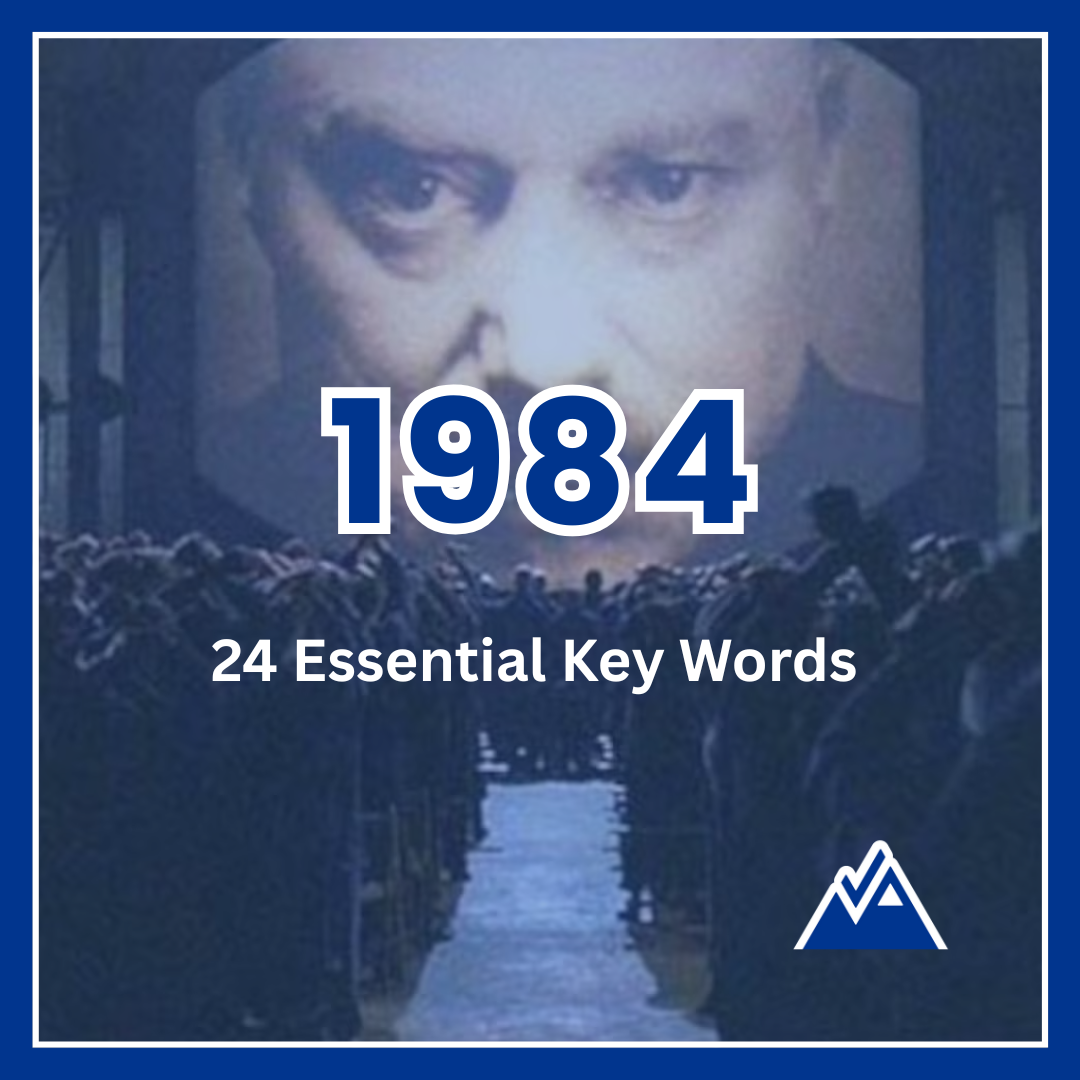
Orwell’s novel does not simply tell a story; it presents a bleak political warning about a world in which power is absolute, truth is manufactured, and individual identity is systematically erased.
To write about 1984 with confidence, students need more than a basic understanding of the plot. Strong analysis requires precise analytical vocabulary that allows you to explain how Orwell constructs his warning and why it remains relevant. Without the right language, ideas can remain vague or descriptive, even when your understanding is sound. Knowing how to accurately describe concepts like ideological control, repression, and the manipulation of language is essential for developing sophisticated arguments and writing essays that move beyond retelling the story.
This guide brings together the essential terms every Year 12 student should know when studying 1984. Each term is clearly defined and directly linked to the novel, with explanations of how it applies to Orwell’s ideas and how it can be used effectively in an essay. By the end of this guide, you should feel more confident not only in understanding the novel’s political concerns, but also in expressing your analysis with clarity and authority.
Ready to get started? Let’s get into it.
Totalitarianism - A political system where the state seeks to control every aspect of citizens’ lives - public, private, and psychological. 1984 depicts a form of totalitarianism in which the Party exerts absolute control over thought, language, memory, and even emotion, leaving no sphere of life untouched by its authority.
Socialism - A political ideology focused on equality, shared ownership, and social welfare. Orwell, a democratic socialist, warns how socialism can be corrupted when placed in the hands of authoritarian leaders who twist its ideals into tools for oppression.
Bureaucratic control - Power maintained through complex rules, administrative procedures, and endless paperwork. The Party’s reliance on bureaucratic control, such as constant rewriting of documents in the Ministry of Truth, turns administration into a means of surveillance and manipulation.
Humanism - A belief system that values individual dignity, freedom, and moral choice. Winston’s desire to love Julia and think freely reflects a form of humanism that directly opposes the Party’s attempt to erase personal identity.
Dystopian - Describing an imagined society defined by suffering, oppression, and loss of freedom. Orwell creates a dystopian world to show how fear, surveillance, and propaganda can destroy individuality and truth.
Rebellion - Resistance against authority or established power. Winston’s diary function as a small but dangerous act of rebellion, marking his first attempt to assert a self outside Party control.
Subversion - The act of undermining or weakening an authority from within. The Party fears intellectual subversion, which is why independent thought, or “thoughtcrime”, is punished so severely.
Subjugated - Forced into obedience or control by a more powerful group. The citizens of Oceania are subjugated through a combination of fear, surveillance, and linguistic manipulation.
Conformity - The pressure to behave or think in accordance with a dominating group or authority. In 1984, conformity becomes a survival mechanism; citizens learn to hide their true thoughts to avoid punishment.
Dehumanisation - The process of stripping people of individuality, identity, or dignity. The Party’s rituals, propaganda, and surveillance contribute to the dehumanisation of individuals, reducing them to obedient tools of the regime.
Cognitive dissonance - The mental discomfort caused by holding two contradictory ideas at the same time. Slogans like “War is Peace” purposely create cognitive dissonance, making citizens dependent on the Party to resolve contradictions.
Mimesis - The imitation or representation of reality in literature. Orwell’s use of mimesis makes the world of 1984 disturbingly realistic, showing how political manipulation can distort everyday life.
Surveillance - Constant monitoring of people’s actions and, in Oceania’s case, their thoughts. Big Brother’s omnipresent surveillance conditions citizens to self-police, blurring the line between external control and internal fear.
Propaganda - Biased or misleading information used to shape public opinion.The Party relies on propaganda to control how citizens perceive history, language, and even their own emotions.
Censorship - The suppression, alteration, or destruction of information to control what people can know or think. Through relentless censorship, the Ministry of Truth erases inconvenient realities, making independent memory impossible.
Authentic - Genuine; aligned with one’s true thoughts, feelings, or identity. Winston longs for authentic human connection, which the Party systematically destroys.
Inauthentic - Artificial, false, or shaped by external pressures rather than inner truth. Public displays of loyalty in 1984 are deeply inauthentic, performed not out of belief but out of fear.
Destabilisation - The act of undermining stability, certainty, or confidence. The Party uses destabilisation, especially through shifting historical records, to prevent citizens from trusting their own memories.
Marginalisation - Pushing individuals or groups to the edges of society, limiting power and influence. The proles are deliberately marginalised, excluded from political life so they remain harmless and unaware of their collective power.
Diegetic politics - The political structures, hierarchies, and systems operating within the fictional world of a text. Understanding the diegetic politics of Oceania, such as the Inner Party, Outer Party, and proles, helps explain how power is unevenly distributed.
Ideological and political hierarchies - Systems that rank people based on beliefs, authority, or access to power. Oceania’s ideological and political hierarchies ensure the Inner Party controls truth while everyone else remains powerless.
Self-actualisation - The process of fulfilling one’s potential or living according to one’s authentic self. Winston seeks self-actualisation by pursuing truth and love, but the Party destroys any attempt to develop a personal identity.
Exploitation - Using people or resources unfairly for one’s own benefit. The Party’s exploitation of the proles ensures a labour force that supports the regime without posing a threat to it.
Metalanguage - The specialist vocabulary used to analyse texts and ideas. Strong metalanguage allows students to analyse 1984 with precision, discussing concepts like surveillance, ideology, and conformity effectively in essays.
Looking for some extra help with your 1984 essay?
We’ve got an incredible team of English tutors at Pinnacle Learners!
If you’re studying Macbeth, we’ll help you strengthen your essay writing and build the confidence to ace your next assessment.
We offer flexible one-on-one lessons, available both online and in person at our Rozelle office, supporting students across Sydney’s Inner West, including Balmain, Leichhardt, and surrounding suburbs to excel.
Over the years, our students have consistently improved their results - many by 20% or more - through expert guidance, proven strategies, and mentoring that goes well beyond the textbook. If you’re looking for support that builds real understanding and lasting skills, we’d love to help.