
How to Study Like a 99 ATAR Student

Every year, thousands of students dream of achieving a 99+ ATAR. And while it may seem impossible from the outside, students who reach this level rarely rely on “genius” or natural talent. In reality, high-performing students use specific, repeatable study habits that anyone can learn.
At our tutoring centre, we’ve supported countless students who started in the middle of the cohort and climbed to exceptional results, achieving over 99 ATARS by using the same four principles outlined below.
This guide breaks each principle down into actionable steps, so you can study smarter, improve faster, and move closer to your dream ATAR.
Ready to get started?
Let’s dive in.
Step 1: Plan Your Study with Intention
Most students begin a study session by opening a textbook and hoping motivation will do the rest. Top ATAR students do the opposite, they remove all the uncertainty by planning exactly what they will do before they start.
If you can clearly define what, how, and when you’ll study, you eliminate wasted time and dramatically increase the quality of your learning.
a) WHAT: Know exactly what you’re trying to achieve
The most underrated study skill is specificity.
Instead of saying “I’m going to study Chemistry today,” a 99 ATAR student decides: “I’m revising Acids & Bases: titration curves, indicators, and strong vs weak acids, and I’m going to memorise my notes and complete 5 practice questions for each sub topic.”
Being precise forces your brain to focus instead of drifting. pecific goals activate what's called directed attention: you learn faster because your brain knows what information to prioritise.
A strong WHAT plan should include: Key syllabus dot points, the exact concepts you’re revising and the question sets or chapters you’re completing.
Write everything down before you start to make a checklist for each study session.
b) HOW: Choose the highest-impact study method
This is where average students and elite students differ most dramatically. The method you choose matters just as much as the content. Top students prioritise:
Active recall → quizzing yourself instead of rereading
Spaced repetition → reviewing information at optimal intervals
Practice questions → applying theory under exam-like pressure
If you can match each topic with the most effective study method, your memorisation, understanding, and exam performance will improve exponentially.
For example, for memorising legal definitions, try creating flashcards (quizlet, anki or physical ones) using active recall. For learning maths processes, use exam style practice questions to test your knowledge. For science concepts, use short answer questions, and for english, use spaced repetition to nail down your quotes and techniques.
c) WHEN: Structure your study time like an appointment
High-achieving students don’t leave study time up to mood or motivation—they lock it into a clear schedule.
A strong WHEN plan includes: start and finish times, subject blocks, break intervals and a realistic, consistent routine
Why planning your time matters: Decision fatigue kills motivation. If you know exactly when you’re studying, you’re far more likely to follow through, especially during high-pressure exam periods.

Sample weekly study plan
Step 2: Practice. Practice. Practice. (The Real Secret)

Here’s the truth: Achieving high marks has far less to do with intelligence and far more to do with the number of questions you expose yourself to. Many students spend hours rewriting notes, highlighting, or watching videos, but none of that replicates the conditions of an exam. Top ATAR students prioritise practice because:
It reveals weaknesses fast
It trains you to think like the exam
It familiarises you with question patterns
It reduces anxiety through repetition
The more questions you complete, the less unpredictable your assessment becomes.
How to Practise Effectively (not just frequently)
1. Start earlier than you think: Don’t wait until “the content is finished.” You can (and should) start practising from Week 1. If you wait until you get your assessment notificaiton, you’ll have just two weeks to learn a whole terms content (and the same to do for all of your subjects).
2. Use NESA marking criteria to self-mark: This is a game changer. You will instantly see: what markers reward, what they ignore and what your answer is missing
3. Track your errors: A simple mistake log can increase your marks faster than anything else. Record: what went wrong, why it happened, what concept it links to and how you’ll fix it
4. Simulate exam conditions: The biggest difference between top and average students is familiarity with pressure. Timed practice = exam confidence.
Step 3: Prioritise Your Weaknesses (Not Your Strengths)
This is the principle most students resist, yet it’s the one that skyrockets ATAR scores the fastest. Students love studying their “good subjects” because it feels safe, easy, and makes you feel confident in your own abilities and potentials. But top performers deliberately target their worst subjects because those marks have the largest room for improvement.
Why improving weak subjects boosts your ATAR the most:
The ATAR is percentile-based, meaning improvements aren’t equal at every mark range. For example:
Moving from 85 → 95 might raise your rank by ~8 percentiles.
Moving from 50 → 70 can raise it by 30–35 percentiles or more.
This is why focusing on weaknesses is the highest-return strategy you can implement.
Ask yourself: Which subjects do I avoid? Which topics consistently cause mistakes? Which skills drop under exam conditions? Where do I lose the most marks on past papers?
A 99 ATAR student looks their weaknesses in the eye. Average students avoid them.
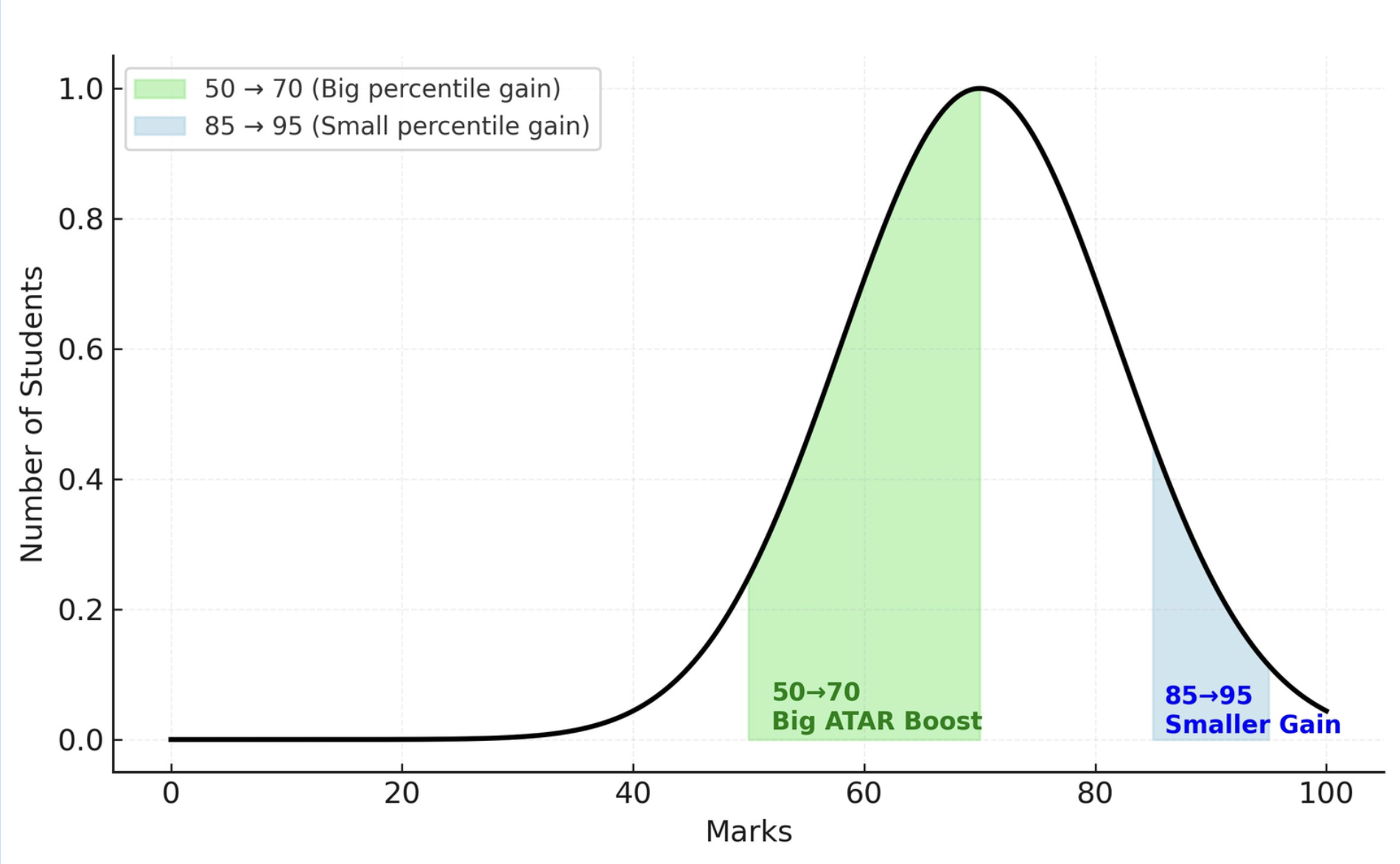
Comparison of the gain difference between 50 -70, and 85-95.
How to improve weak areas quickly
Relearn the foundation: Most weaknesses come from a missing fundamental. Filling the gap fixes everything above it.
Do targeted practice, not full papers: If your weakness is “short answers for Module 5 in Biology,” focus only on that skill for a week.
Ask for feedback early: Teachers and tutors can correct misunderstandings long before they become assessment problems.
Turn your weakness into a system: Once you know what’s going wrong, build a routine around correcting it.
Step 4: Study Smarter, Not Harder (What Actually Separates Top Students)
Many students believe more hours = better marks. But top ATAR students know that what you do matters far more than how long you do it. They focus on high-impact strategies that produce real improvement, not just busywork (ie putting in more hours)
a) Active recall beats passive study
Re-reading notes feels productive but produces almost no long-term memory. Active recall forces your brain to retrieve information, which: strengthens memory, improves exam performance and deepens understanding
Some examples include: closed-book quizzes, flashcards, blurting (writing everything you remember) and teaching the concept aloud to friends and family.
b) Timed questions over endless rewriting
If you want to perform under pressure, you must practise under pressure.
Timed questions teach you: how quickly to write, how to prioritise marks, how to prevent overthinking and how to stay calm
c) Quality over quantity
One hour of deep work beats three hours of distracted study. High achievers refine their environment: they put their phone in another room (or use an app like YPT or Flora to lock and track their study), they create a clean desk and clear tasks to complete, and they build in structured breaks to create rewards and ensure they don’t get burnt out.
What matters is intensity - not duration.
Ready to Study like a 99 ATAR Student?
We’ve got an incredible team of tutors and mentors here at Pinnacle Learners!
If you need some help building a strong study schedule or routine, we’ll help you make a clear and detailed plan to ace your next exam block.
Our one-on-one lessons are available online or in person at our office in Rozelle, giving students across Sydney’s Inner West (Balmain, Leichhardt and beyond) the support they need to excel.
Over the years, our students have boosted their results by 20% or more through expert guidance, proven strategies, and mentoring that goes beyond the textbook. If you’d like personalised help building a study plan tailored to your subjects, strengths, and assessment schedule, our tutors can guide you step-by-step.
