
An In-Depth Guide to Donne’s “If Poisonous Minerals”
If you’re studying Donne’s oeuvre for Module A and finding ‘If Poisionous Minerals’ a little challenging: you’re in the right place.
Written during a period of religious instability following the Reformation, the convoluted sonnet reflects a profound spiritual anxiety about the possibility of salvation, where the speaker attempts to use logic and argument to question God’s justice only to realise that reason is ultimately insufficient in matters of faith. This is the often the first poem studied of Donne’s works as it demonstrates how a tightly controlled form and metaphysical style can work together to represent the spiritual uncertainty of the Renaissance era.
This guide aims to walk you through everything you need to know about the poem for Module A. We’ll start by exploring the religious anxieties of Renaissance England and explaining how they shape the poem, before then moving onto an analysis of the petrarchan sonnet form and Donne’s stylistic metaphysical wit. The poem will then be broken down and analysed line-by-line, before finishing up by linking the poem to its textual conversation with W;t.
Let’s get into it.
Donne’s Context
The fear and uncertainty that dominate “If Poisonous Minerals” are closely connected to the world Donne lived in. He was writing in England during the late sixteenth and early seventeenth centuries, a time when Christianity was deeply divided as a result of the Protestant Reformation. There was no longer one clear set of beliefs about how salvation worked. Different churches argued over whether faith alone was enough, whether good works were required, and how harsh God’s judgement might be. For ordinary believers, this created confusion and anxiety. Many people worried constantly about whether they were truly saved. Religion at this time often focused heavily on sin and judgement. Sermons regularly reminded people of hell and punishment, which only increased fear. Donne’s poem reflects this atmosphere. The speaker is not calmly trusting God; instead, he is preoccupied with the idea that he might be condemned despite trying to understand and do the right thing.
Donne’s own life made these fears more personal. He was born into a Catholic family at a time when Catholicism was illegal in England, and members of his family were punished for their faith. Later in life, Donne converted to Anglicanism and eventually became a minister, but this change did not erase his doubts. Instead, his religious poetry often shows a mind that is restless and questioning. His speakers frequently struggle with faith rather than accepting it easily.
At the same time, Donne lived within the Renaissance period, which brought a resurgence of learning and the increased circulation of ideas. New scientific thinking and discoveries began to challenge inherited assumptions about the universe and humanity’s place within it. It was essentially a conflict between old and new paradigms: science versus religion, faith versus method, submission versus investigation. This is directly relevant to Donne because his speakers frequently behave like Renaissance thinkers: they push ideas hard, test them, and demand explanations. Renaissance humanism also encouraged confidence in human intellect, dignity, and reason. However, Christian doctrine often insists that salvation ultimately depends on God’s grace, not on a person’s intellectual ability. That tension becomes the engine of this poem. Donne’s speaker begins by pressing a logical case against damnation, but the poem dramatizes how reason runs into a wall when confronted with divine authority.
Importantly, Donne’s Holy Sonnets are “the product of a doubter.” They do not sound like settled devotion. They sound like a speaker trying to think his way into spiritual safety, and finding that the mind cannot guarantee comfort. This is framed as the poem’s meditation on “the truthfulness of faith,” and as Donne’s characteristic movement toward a different ending than the poem seemed to promise at the start.
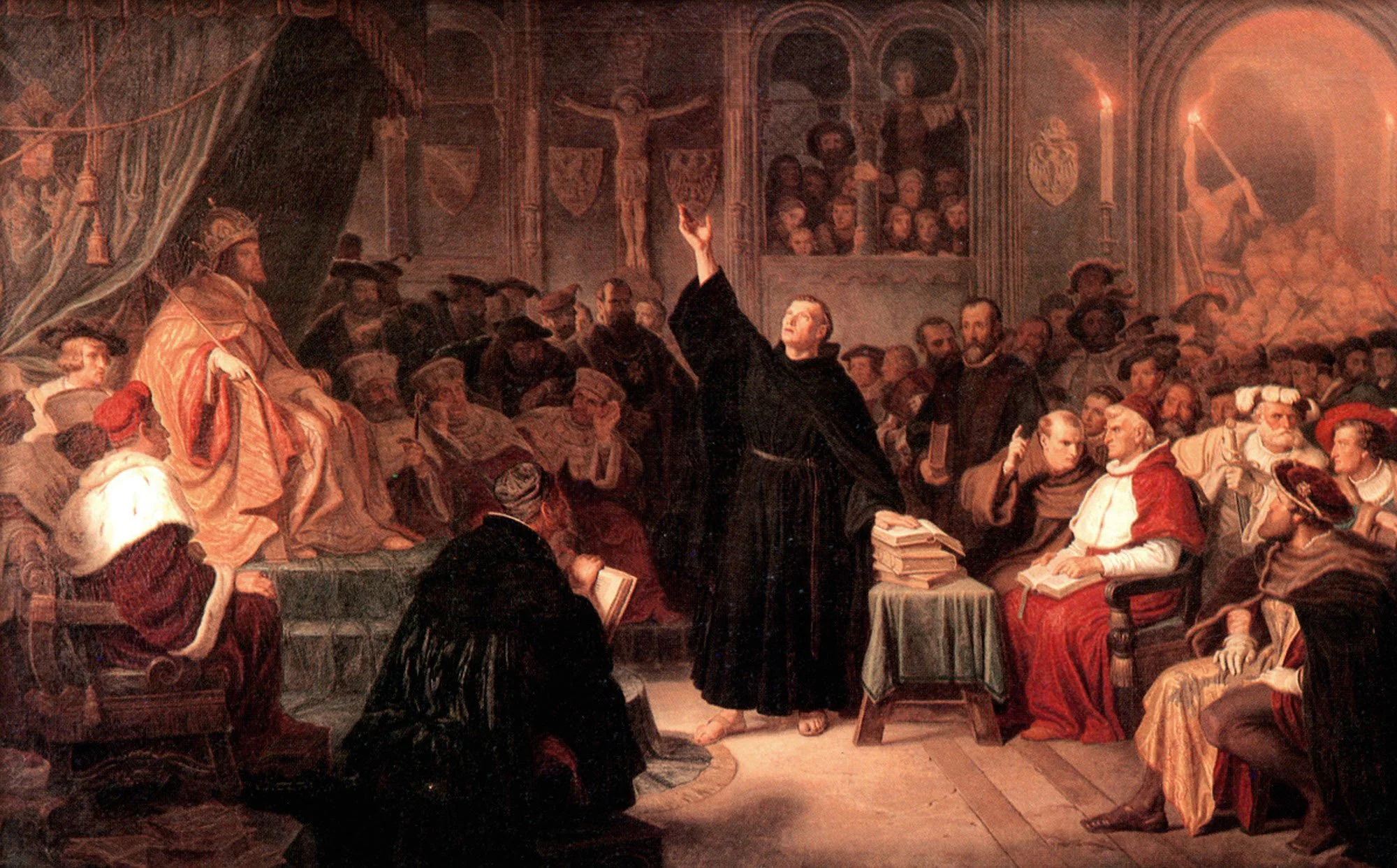
The Protestant reformation - a religious movement that challenged the authority of Catholicism & led to the creation of Protestant churches
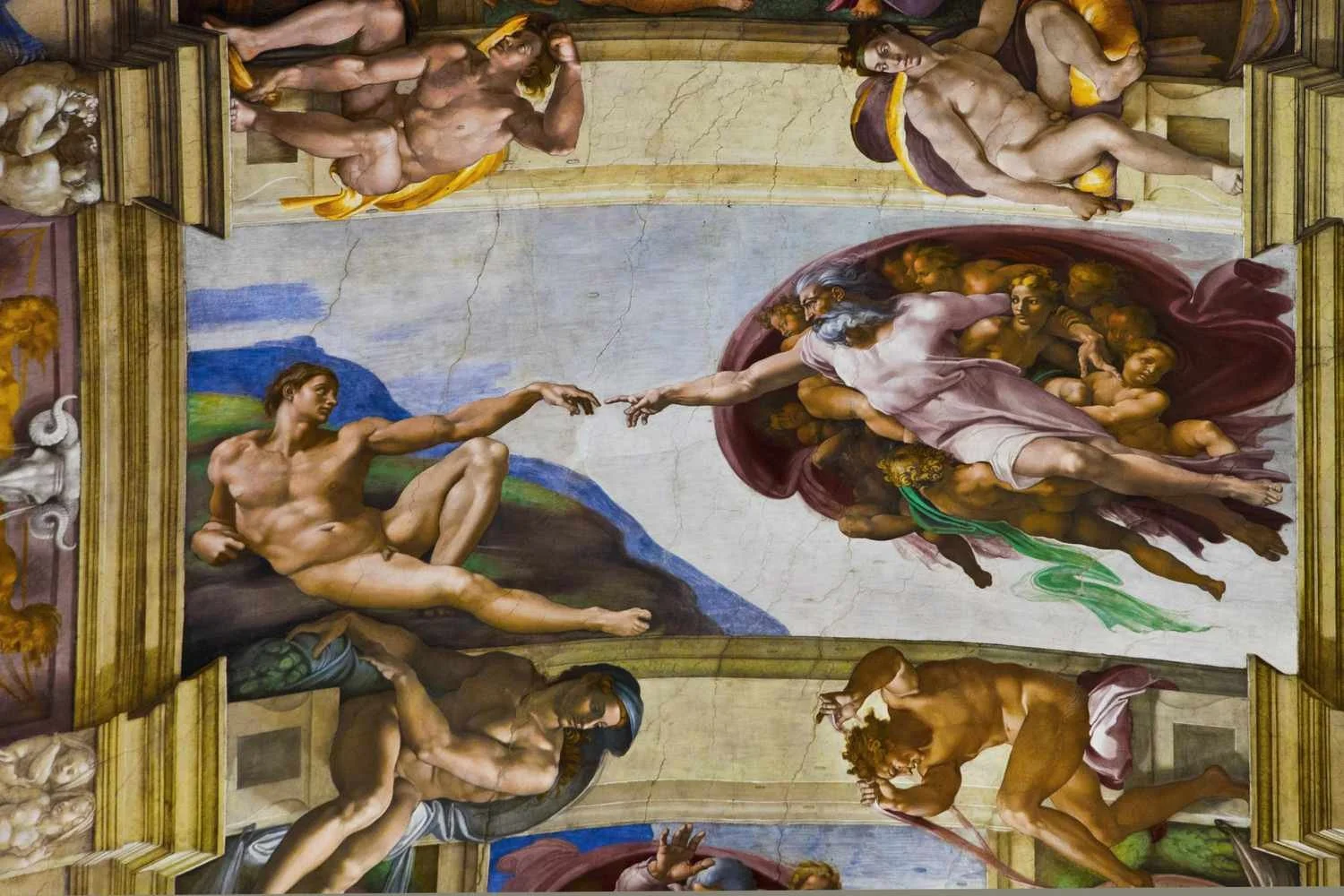
Michelangelo's iconic fresco ‘The Creation of Adam’ - one of the most famous paintings of the Renaissance period
The Sonnet Form
Donne writes the poem within a Petrarchan (Italian) sonnet: 14 lines, iambic pentameter, split into an:
Octave (lines 1–8): the proposition or problem
Sestet (lines 9–14): the response or attempted resolution
Volta at line 9: the turning point in logic and tone
The poem is written as a Petrarchan sonnet, and this structure helps shape the speaker’s argument. The first eight lines, known as the octave, focus on questioning and reasoning. In this part of the poem, the speaker builds an argument against damnation by asking a series of challenging questions. The tone feels urgent and pressured, as though the speaker believes that careful reasoning might expose a flaw in God’s judgement. This reflects the Renaissance belief that logic can lead to truth.
The volta occurs at the beginning of the sestet (lines 9-14), where the speaker suddenly changes direction. He realises that his argument has gone too far and that he is effectively challenging God’s authority. From this point on, the poem becomes less argumentative and more humble. Instead of trying to prove something, the speaker begins to ask for mercy. Although the sonnet ends in a formally neat way, the emotional tension does not disappear. The speaker is still unsure, which reinforces the idea that faith does not always provide clear or comforting answers.
Donne’s metaphysical “wit” is ingenious thought that shocks the reader into reconsidering assumptions. It is the power to “amuse surprise,” but not in a comedic sense. In this poem, wit shows up as:
Unusual comparisons: minerals, goats, snakes, and a tree used as theological evidence
Paradox: the poem is full of paradoxes, particularly the idea that God is both merciful and threatening, and that human reason is both a gift and a source of greater guilt
Dense conceits and allusions: Genesis sits beside Greek mythology (Lethe) and ledger/debt language
Conversational tone: which makes the poem feel like we are listening to the speaker think aloud, which helps the reader follow his emotional struggle.
Line-by-Line Analysis
If poisonous minerals, and if that tree
Whose fruit threw death on else immortal us,
If lecherous goats, if serpents envious
Cannot be damn'd, alas, why should I be?
At the opening of the poem, Donne’s speaker immediately adopts an argumentative tone, using logic and comparison to question the justice of divine punishment. Rather than beginning with prayer or praise, the speaker launches into a series of conditional statements that frame the poem as a rational dispute. These lines introduce the speaker’s central fear — damnation — and establish the key idea that humans may be unfairly punished for sin in a world where other harmful forces escape judgement. Donne uses repeated conditional clauses (“If… and if… If… if…”) to create a piling, almost breathless rhythm that mimics the speaker’s anxious thinking. This technique also reflects Renaissance practices of formal argument and disputation, showing the speaker’s confidence in reason as a tool for truth. The examples chosen are loaded with symbolic meaning: “poisonous minerals” represent natural substances that cause death without intent; “that tree” alludes to the Tree of Knowledge in Genesis, whose fruit initiated the Fall; “serpents” evoke Satan’s temptation of Eve; and “lecherous goats” symbolise lust and sin. By listing agents of harm that are not damned, the speaker constructs a fairness argument, suggesting that moral accountability depends on consciousness and intent. The rhetorical question in the final line, intensified by the emotional interjection “alas,” exposes the speaker’s fear and frustration. Structurally, these lines form the opening movement of the octave, establishing the poem’s intellectual pressure and positioning reason as the speaker’s initial defence against damnation.
Why should intent or reason, born in me,
Make sins, else equal, in me more heinous?
And mercy being easy, and glorious
To God, in his stern wrath why threatens he?
In the second half of the octave, the speaker moves away from concrete examples and focuses instead on the underlying principles of sin and judgement. He begins to interrogate the logic of human responsibility, questioning why reason, a quality given by God, should increase guilt rather than mitigate it. These lines deepen the poem’s central paradox and intensify the speaker’s anxiety. Here, Donne shifts into abstract diction, using terms such as “intent,” “reason,” and “heinous,” which draw on legal and moral vocabulary. This reflects the speaker’s attempt to analyse salvation as if it were a system of justice or law. The phrase “born in me” suggests that reason is innate and God-given, intensifying the speaker’s frustration: he feels condemned by the very qualities that define his humanity. Donne employs paradox in presenting God as both merciful and wrathful, exposing a contradiction that the speaker cannot reconcile. The balanced phrasing of “easy, and glorious” contrasts sharply with “stern wrath,” heightening the sense of theological inconsistency. These lines complete the octave’s argumentative build-up, reflecting Renaissance confidence in rational inquiry while also revealing its emotional motivation — fear of judgement. The speaker’s logic is increasingly strained, preparing the poem for the collapse of reason at the volta.
But who am I, that dare dispute with thee,
At this point in the sonnet, the speaker abruptly recognises the limits of his reasoning. The poem turns away from argument and toward self-awareness, marking a shift in both tone and method. This line functions as the poem’s intellectual and emotional turning point. The conjunction “But” immediately cancels the momentum of the previous argument, signalling a reversal in attitude. The rhetorical question “who am I” introduces humility and self-rebuke, while the verb “dispute” reframes the octave’s reasoning as confrontational and presumptuous. This moment reflects Christian teachings about humility before God and exposes the danger of relying too heavily on human reason. In terms of sonnet form, this is the volta that separates the argumentative octave from the submissive sestet. Contextually, it mirrors the tension in Donne’s world between Renaissance confidence in intellect and Reformation-era anxiety about divine authority. Reason, which once seemed powerful, is now revealed as inadequate.
O God? Oh, of thine only worthy blood
And my tears, make a heavenly Lethean flood,
And drown in it my sins' black memory.
Following the volta, the speaker abandons debate and turns toward prayer and supplication. These lines shift the poem’s focus from intellectual argument to emotional vulnerability, as the speaker seeks not explanation but mercy. Donne’s metaphysical style becomes most intense here through the use of an extended conceit. The direct address to God through apostrophe and the exclamatory “O God? Oh” convey hesitation and emotional strain. The reference to Christ’s “only worthy blood” aligns with Christian doctrine that salvation comes through Christ’s sacrifice, not human effort. Donne then introduces a metaphysical conceit by combining Christ’s blood with the speaker’s tears to create a “heavenly Lethean flood.” The classical allusion to Lethe, the river of forgetfulness in Greek mythology, is deliberately fused with Christian imagery, creating an intellectual collision typical of metaphysical poetry. This fusion suggests that the speaker desires not only forgiveness but complete erasure of guilt. The verb “drown” intensifies this desire, implying total submersion, while “sins’ black memory” uses colour symbolism to represent lingering shame. These lines reveal the psychological depth of the speaker’s fear and show repentance replacing argument as the only remaining response.
That thou remember them, some claim as debt;
I think it mercy, if thou wilt forget.
In the final couplet, the speaker reflects on two different ways of understanding justice and mercy. While the sonnet form suggests closure, the poem’s emotional state remains unresolved, reinforcing its theme of spiritual uncertainty. Donne introduces legal and financial metaphor through the word “debt,” reflecting a common early modern view of sin as something that must be accounted for and repaid. By attributing this view to “some,” the speaker distances himself from strict moral accounting. Instead, he proposes that true mercy lies in forgetting sin altogether. The phrase “I think” signals personal belief rather than doctrinal certainty, and the conditional “if thou wilt forget” leaves the poem open-ended. Although the sonnet ends formally, it concludes in hope rather than assurance. This unresolved ending reflects Donne’s religious context and reinforces the poem’s central message: reason cannot guarantee salvation, and faith must exist alongside uncertainty.
Resonances Between Donne and Vivian
“If Poisonous Minerals” and W;t engage in a sustained textual conversation about the role and limits of human reason when individuals confront fear, suffering, and mortality. Both texts centre on highly intellectual personas who initially rely on intellect as a means of control and protection. Donne’s speaker attempts to reason his way through questions of sin, mercy, and damnation, while Vivian Bearing uses her formidable academic intellect to manage the experience of illness and the prospect of death. In both cases, reason is treated as a way of imposing order on chaos and of distancing the self from emotional vulnerability.
However, both texts progressively expose the limitations of this reliance on reason. In Holy Sonnet IV, Donne presents reason as capable of identifying logical contradictions within theological doctrine, yet ultimately incapable of providing spiritual certainty or salvation. The speaker’s arguments culminate in the recognition that disputing with God is an act of arrogance, prompting a turn toward humility and supplication. Similarly, W;t reframes this struggle in a modern, secular context as Vivian’s intellectual mastery allows her to dominate academic spaces, but it proves powerless in the face of physical suffering. Edson’s play therefore echoes Donne’s concern with the inadequacy of intellect, while relocating it within the medical and institutional frameworks of the late twentieth century.
A key point of resonance between the texts is their shared exploration of wit. Donne’s metaphysical wit enables him to construct intricate theological arguments through paradox, allusion, and conceit, while Vivian’s academic wit manifests in sharp irony, verbal precision, and scholarly authority. In both texts, wit is associated with confidence and control. Yet this shared reliance on wit is ultimately destabilised as Donne’s intellectual brilliance does not alleviate his fear of damnation, and Vivian’s wit cannot shield her from the emotional and physical realities of terminal cancer. Through this parallel, W;t does not reject Donne’s ideas but extends them, demonstrating that intellectual sophistication remains insufficient when individuals confront their own mortality.
Looking for some extra help with your Donne and W;T essay?
We’ve got an incredible team of English tutors at Pinnacle Learners!
If you’re studying Donne and W;t for Module A, we’ll help you strengthen your essay writing and build the confidence to ace your next assessment.
Our one-on-one lessons are available online or in person at our office in Rozelle, giving students across Sydney’s Inner West (Balmain, Leichhardt and beyond) the support they need to excel.
Over the years, our students have boosted their results by 20% or more through expert guidance, proven strategies, and mentoring that goes beyond the textbook. If you’re looking for support that builds real understanding and lasting skills, we’d love to help.
