
The Highest Scaling HSC Subjects (based on 2025 statistics)
Every year, one of the most common question students ask is:
“What subjects scale the best?”
Using the official 2025 NSW HSC scaling data, we can now see exactly which subjects scaled the highest and why - and more importantly, what this means for your subject choices.
But before we jump in, let’s clear something up: Scaling does not reward subjects, it just reflects the strength of the cohorts. Scaling exists to even out ‘easier’ and ‘harder’ courses o that everyone is treated fairly when calculating their ATAR. Choosing high-scaling subjects won’t guarantee you a high ATAR, and likewise, you can still achieve a 99+ ATAR with almost any combination of courses. The most important thing to keep in mind when selecting courses is to choose subjects that you are good at, and more importantly, that you enjoy.
All data below comes from the 2025 Preliminary Report on the Scaling of the NSW HSC published by UAC/NESA.
What is Scaling (and How Does it Work)?
Before we get into the data, let’s clarify what scaling is. Scaling is the process used by UAC (the University Admissions Centre) to adjust HSC marks so results from different subjects can be fairly compared.
You might be thinking: why is this needed?
Well, it’s because if a few reasons, mainly because
1. Some subjects have a much stronger cohort than others (meaning competition is tougher and more fierce)
2. Some subjects are taken mostly by high achieving students (For example, Extension and Advanced courses)
3. Some subjects are taken by a very wide range of abilities (meaning there are both very high and very low scorers).
Scaling doesn’t judge the difficulty of a subject (although it can be an indicator), it instead adjusts marks based on the academic strength of the students taking that course.
So for example, if a subject is mostly taken by very strong students, then a mark of 75 would be very impressive, and subsequently get scaled up to an 80. Conversely, if a subject has a very mixed cohort, a 75 might not represent the same level of academic strength, so it may scale down to a 70 or 65.
UAC looks at how students in each subject perform across all their other subjects to see the overall academic strength of the cohort. If students in Subject A also do very well in their other subjects, then Subject A is considered a strong cohort subject & scales up. If students in Subject B, on average, perform poorer in their other subjects, it scales down.
So… What Were the Highest Scaling Subjects in 2025?
Before we list the subjects, it’s important to explain exactly how this ranking is calculated. There are two different ways people talk about “high scaling”:
1. How strong the students in the subject are (mean scaled mark), and’
2. How much UAC increases the marks compared to the raw HSC marks (ie what you achieved in the exam).
In other words, for each subject we calculate the difference between the average scaled mark and the average raw HSC mark to find the “scaling boost”, which shows us which subjects receive the biggest increase from scaling. Although UAC performs scaling internally on a 50-point per unit scale, we have converted all figures to marks out of 100 to make them easier to understand.
1) Mathematics Extension 2
The average HSC mark is approximately 67, yet the average scaled mark is 87. This means that the average scaling boost is + 20 marks
This is the biggest scaling boost in the entire HSC. The subject is very hard to score highly in, but the students taking it are extremely strong, so UAC scales it up heavily. For example, if you received an 80 as your raw mark, you would be scaled up to a mark of 92-94.
2) Latin Extension
The average HSC mark is approximately 68, while the average scaled mark is approximately 85. This means the average scaling boost is +17 marks
This is one of the strongest scaling subjects in the entire HSC. The cohort is very small and made up almost entirely of top academic students (mostly because it is only offered at top private and selective schools), so UAC scales it up significantly. For example, if you received an 80 as your raw mark, you would typically be scaled up to around 89–91.
3) French Extension
The average HSC mark is approximately 66, while the average scaled mark is approximately 78. This means the average scaling boost is +12 marks
French Extension is a very demanding course with harsh marking, but it attracts a very strong cohort, so UAC compensates by scaling it up. For example, if you received an 80 as your raw mark, you would typically be scaled up to around 85–87.
4) Italian Extension
The average HSC mark is approximately 68, while the average scaled mark is approximately 79. This means the average scaling boost is + 11 marks
Like most language extension courses, Italian Extension is difficult to score highly in, but the cohort is academically strong, so it scales up significantly. For example, if you received an 80 as your raw mark, you would typically be scaled up to around 84–86.
5) German Extension
The average HSC mark is approximately 69, while the average scaled mark is approximately 77. This means the average scaling boost is + 8 marks
German Extension has a small but very strong cohort, and marks are relatively hard to earn, so it receives a solid scaling boost. For example, if you received an 80 as your raw mark, you would typically be scaled up to around 82–84.
Other Subjects
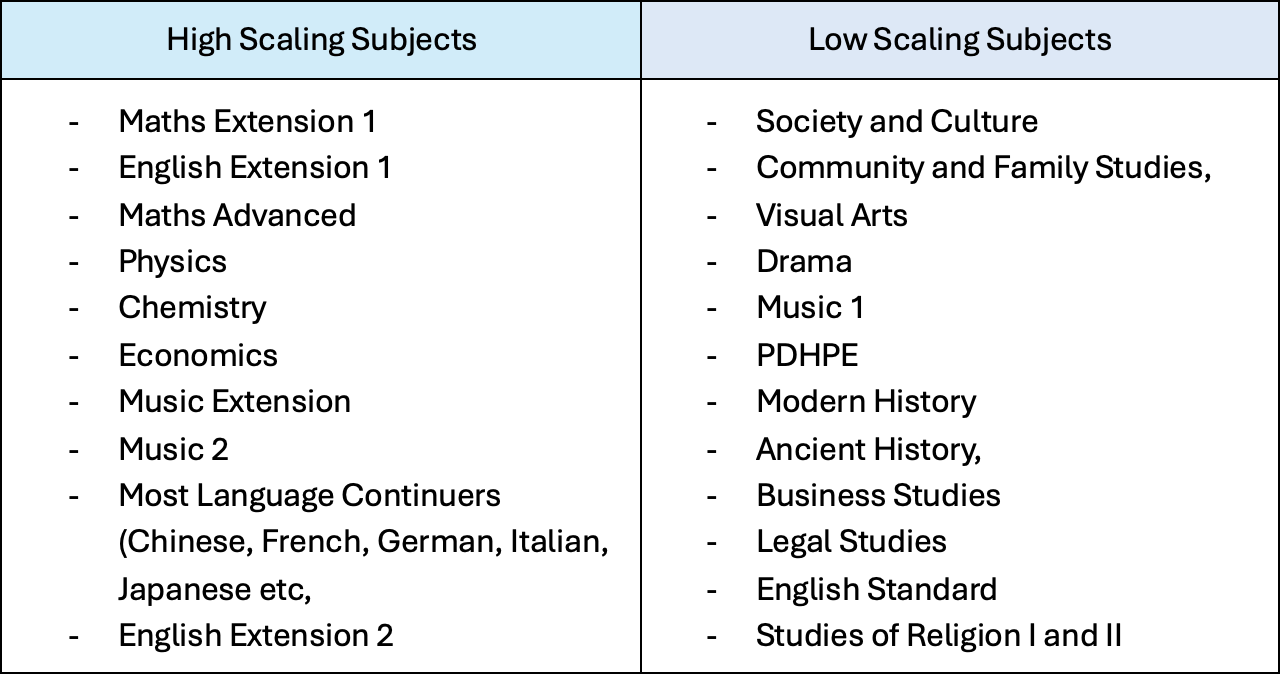
High Scaling subjects typically are hard to score highly in, have strong cohorts and therefore get scaled up to compensate. For example, as shown earlier in this article, an 80 in Maths Extension 2 can scale into the low-to-mid 90s, whereas an 80 in many other subjects would not.
Low Scaling Subjects usually have very large cohorts, have a wide range of student ability, and/or have generous marking, meaning lots of students score high raw marks. Because of this, UAC typically scales them down. It is common in these subjects for a raw 80 to scale a 70–75, depending on the cohort.
This does NOT mean that low scaling subjects are “bad” subjects. In fact: A 90 in Business Studies or Legal Studies will almost always beat a 70 in a high-scaling subject like Physics or Maths Extension 1. Every year, many students achieve 95+ and even 99+ ATARs with combinations that include Business, Legal, PDHPE, or similar subjects - because they score extremely well in them.
So How Should This Actually Affect Your Subject Choices?
After seeing all this data, you might be thinking that you should just pick subjects that scale the most. But for most students, the answer is a resounding NO.
When choosing your subjects, you should prioritise: subjects you are naturally good at (based on junior years), subjects you can realistically score 80–90+ in, and subjects you enjoy so you can stay motivated to study them two years.
Scaling will take care of itself if you are performing well.
High-scaling subjects are a great choice if you are genuinely strong in that area. For example, if you are very strong at maths, you should consider Advanced and possibly Extension. If you enjoy languages and have studied them before (or speak one at home), a Continuers or Extension course may be a great option.
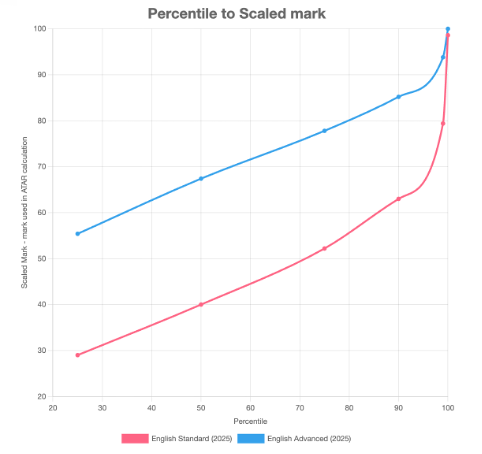
For example, looking at the graph to your left, when we compare English Advanced and English Standard – you would need to be in the top 10% of English Standard students, to achieve the same mark as a top 75% (ie below average) English Advanced student. In this case, it would be advisable to take English Advanced if you are sitting around or just below average.
Want Help Choosing the Right Subjects?
We’ve got an incredible team of tutors at Pinnacle that can help!
At Pinnacle Learners, our experienced tutors don’t just help students improve in individual subjects- we help them build a plan, strengthen their skills, and stay confident and consistent throughout the year.
We offer one-on-one tutoring both online and in person at our office in Rozelle, supporting students across Sydney’s Inner West (Balmain, Leichhardt and beyond).
Over the years, our students have boosted their results by 20% or more through expert guidance, proven strategies, and mentoring that goes far beyond the textbook.
