
Tackling Short Answer Questions
While essay preparation for Paper 1 and Paper 2 is often straightforward, short answer questions (SAQs) are where many students struggle to score highly. Despite knowing the content, students are frequently unsure how to structure their responses, select techniques efficiently, and manage time under exam conditions.
Because short answer questions require students to analyse texts and construct mini body paragraphs under pressure, they are one of the most challenging components of the exam. This guide breaks down a more efficient way of thinking about short answers, with a focus on identifying techniques quickly and maximising marks.
While preparation for essays in Paper 1 and 2 are quite straightforward, short answer questions are often an area in which students struggle to score high marks in and are confused in how to improve their approach.
Literary Techniques
To improve performance in short answer questions, it is essential to understand how markers allocate marks.
A common rule taught by teachers and tutors is to aim for one fewer technique than the total marks available. For example, in a four-mark question, students should aim to analyse three techniques.
While this is a useful guideline, it is not foolproof. Markers are not required to reward every technique mentioned. For this reason, students should aim to identify one extra technique as a backup. In a four-mark question, preparing four techniques increases the likelihood of achieving full marks if one point is weaker or less relevant.
Most importantly, markers prioritise quantity and relevance over lengthy or overly complex analysis. Clear, direct explanations linked to the question are far more effective than sophisticated but time-consuming commentary.
The following list categorises a plethora of literary techniques into sections based on their function, it is important to memorise the techniques that come most natural to you, as in the end, markers are looking for the quantity produced rather than how extensive the techniques you’ve chosen are.
Type 1: Drawing Connection
Allusion - Indirect reference to another text/historical event/belief. Compared to intertextuality, allusions are brief and momentary such as in a phrase, whilst Intertextuality is where there is a broad reference to another text which shapes the current one. Effect: creates association with external idea/text/event to either reinforce original idea or transform further.
Metaphor - Compares something to another, unlike simile’s which include ‘like’ or ‘as’. When this comparison exists throughout the text- it’s an extended metaphor. Effect: Attaches properties associated with one object/idea with another, shifting the meaning of the original.
Anthropomorphism - Attaching human qualities to a non-human figure to the extent where they act exactly like a human being. Personification differs with attributing a human feeling/action to the inanimate object. Effect: While personification enhances imagery/qualities of a scene, anthropomorphism uses the non-human figure as a medium to comment on themes/ideas in contemporary society
Pathetic fallacy - When human emotions are specifically attached to nature. E.g. gusts of wind furious of… It can be used to set a mood.
Zoomorphism- When animal qualities are attached to non-human figures. Can be to nature, animalistic is conveyed usually through movement
Type 2: Repetition
Alliteration- Repetition of first letter e.g. burning bright. Effect: creates rhythmic quality, often details genre rather than meaning. Effect; create a mood (for example, repetition of the S sound can build a mood or sense of sinister/dreamy/mysterious/unease), or create emphasis by drawing attention to the sound.
Assonance- Repetition of a vowel sound, importantly it is not just the letter but the pronunciation.
Consonance - when sound of consonant is repeated, similarly the pronunciation sound.
Sibilance - when the letter is ‘s’ is repeated.
Motif - Recurring symbolic reference/object. Can create mood, introduce a main theme, create narrative cohesion, or symbolise something significant in the text.
Plosive - when harsh sounds occur often/more than once .For example:. blow/puncture. When there is a group of plosives it creates a cacophony (opposite of euphony) -> cacophonic/euphonic language
Rhyme schemes: In reference to stanzas/when there is a break between paragraphs
Alternate = ABAB, often in ballads (tells a story and originally set to music)
Coupled = AABBCC/each 2 is a couplet
Monorhyme = AAAA
Enclosed rhyme = ABA/ABBA
Chain rhyme = ABA BCB CDC
Repetition (of words) - creates emphasis, rhythm or emotional intensity.
Anaphora- First word/phrase in the beginning of a sentence is repeated.
Epistrophe - repetition of the word/phrase at the end
Epizeuxis - repetition of a word in close succession (Eg run, run). Can be used to evoke emotion, create immediacy and urgency.
Chiasmus - repetition in direction inversion - For example, when the going gets tough, the tough gets going.
Type 3: Language choice
Modality - The certainty or strenght of the language spoken. The effect is that it conveys the confidence/severity of situation. High modality language may include ‘must’ ‘should’, whereas low modality language is ‘perhaps’ ‘maybe’ ‘might’. Often used in persuasive texts.
Register- includes Slang/Colloquial/Informal/Formal. The higher the register, more sophisticated the language. Effect: infers intellect and creates
Person - First, second, third. Effect: Creates perspective/understanding. When 3rd person, limited narration means we as the reader are not omniscient, thus it is more reflective of real life while building suspense as the audience doesn’t understand everything going on.
Tense - Future, present or past
Type 4: Punctuation
Exclamation- (!) punctuation. Effect: conveys emotional intensity or satirical
Ellipsis - (...) punctuation. Effect: uses dramatic pauses to create tension, satirical to detail scepticism, or a pause to convey unease.
Parenthesis - the insertion of a phrase into a sentence using brackets, commas, or dashes. E.g. He wrote, in grave lettering, that… The effect is that is conveys information, or creates a dramatic pause.
(only poetry) Enjambment- When each sentence runs over instead of being stopped by punctuation. Effect: visually the poem flows better,
(only poetry) Caesura - a pause in middle of line using comma/dash/etc. Compared to parenthesis no extra information is added, it’s effect is instead to create a pause. It can create suspense, reflect the speakers emotions or disrupt rhythm
Miscellaneous:
Archetype - ‘Cliched’ characterisation e.g. the hero archytype. Effect: Reflective of contextual values and belief systems
Hyperbole - Exaggeration. Effect: can be satirical, or convey how important something is to the speaker
Euphemism - Using a mild expression to replace a harsher one - eg saying someone ‘kicked the bucket’ rather than died. Its effect in making something less severe than it is, is that is masks or avoids the explicit nature
Irony - where there is a contradiction between what is said and what isn’t. It can be verbal, situational (eg a firestation catching on fire), dramatic.
Onomatopoeia - where a word reflects sound it represents e.g. drip drop of water
Linearity - Linear/non-linear = sequence of events happening being in order or disrupted by e.g. flashbaccks
Being Efficient with Analysis
Under timed conditions, efficiency is critical. As mentioned earlier, markers for short answers are looking for quantity rather than the extensiveness and complexity of analysis. Your goal should be to identify techniques quickly and link them directly to the question.
Two habits dramatically improve efficiency:
Familiarise yourself with different text types (poetry, prose fiction, images, speeches).
Know which techniques are most common for each text type.
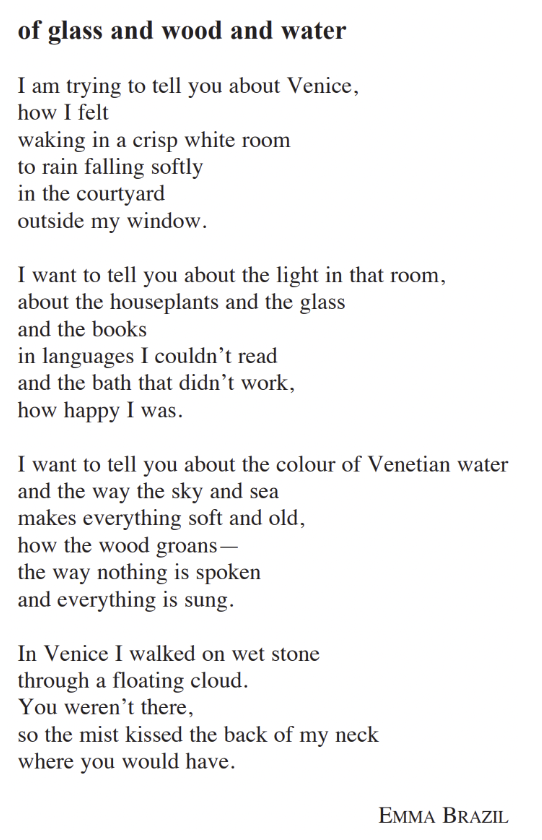
To elaborate on the second point, consider a poem prescribed for Question 1 of the 2024 English Advanced Paper 1: ‘of glass and wood and water’ by Emma Brazil.
When analysing repetition and rhyme, the poem employs anaphora in the opening lines of stanzas two and three, reinforcing the speaker’s cyclical thought patterns and drawing attention to recurring emotional states. This repetition encourages readers to engage more closely with the poem’s reflective tone and underlying concerns.
In terms of punctuation and pace, enjambment is used extensively throughout the poem, allowing ideas to flow across lines and stanzas without interruption. This creates a stream-of-consciousness effect that mirrors the speaker’s internal monologue and contributes to the poem’s contemplative mood. Additionally, the use of caesura in stanza three momentarily disrupts this flow, prompting readers to pause and reflect, thereby emphasising a shift in thought or emotional intensity.
For a four-mark question, further techniques that could be identified include pathetic fallacy, where elements of the natural environment subtly reflect the speaker’s emotional state, and visual imagery, which helps to ground abstract emotions in concrete, sensory detail. Together, these techniques enhance the poem’s ability to communicate meaning succinctly and effectively within a limited response.
The purpose of this example is to demonstrate how different text types privilege particular techniques. Poetry, for instance, often relies on repetition, imagery, and structural features to convey complex ideas efficiently. By understanding which techniques fall under broader categories such as repetition, students can spend less time identifying devices and more time developing insightful analysis that directly engages with the demands of the question.
Looking for some extra help answering Short Answer questions?

We’ve got an incredible team of English tutors at Pinnacle Learners!
If you need some help answering short answer questions, we’ll help you strengthen your technique identification and timed writing skills so you build the confidence to ace your next assessment.
Our one-on-one lessons are available online or in person at our office in Rozelle, giving students across Sydney’s Inner West (Balmain, Leichhardt and beyond) the support they need to excel.
Over the years, our students have boosted their results by 20% or more in just 6 weeks through expert guidance, proven strategies, and mentoring that goes beyond the textbook. If you’re looking for support that builds real understanding and lasting skills, we’d love to help.