
The 10 Most Important Quotes from Othello
Studying Othello and need the key quotes that actually matter for your essays? You’re in the right place.
This play is powered by some of the most psychologically rich and linguistically intricate lines in the entire English canon (or so we think), which help you understand how language becomes weaponised, and perception is slowly reshaped by manipulation.
Below, we’ve selected 10 essential quotes, each unpacked in depth. These lines reveal:
how characters construct and distort identity,
how jealousy, love, and trust can be manipulated through language,
and how Shakespeare blurs the boundary between what is seen, what is believed, and what is true.
If you want to write confidently about Othello in your next assessment task, these are the quotes you NEED to know inside-out.
Lets get into it.
‘Even now, now, very now, an old black ram is tupping your white ewe.’
The insistent repetition of “now, now, very now” creates a sense of breathless urgency, as though Iago is hammering the ghastly image into Brabantio’s mind. The temporal immediacy leaves no room for measured thought, forcing an emotional rather than rational response as Iago constructs an obscene mental picture that overrides whatever Brabantio might previously have believed about Othello.
The animalistic imagery of “an old black ram” and “your white ewe” strips both Othello and Desdemona of human dignity, reducing their marriage to a crude act of breeding. This dehumanisation exposes the xenophobic attitudes embedded within the Elizabethan worldview. The stark juxtaposition of “black” and “white” further encodes the union as unnatural or corrupt, drawing on symbolic associations of whiteness with purity and peace, and blackness with evil and moral disorder. The verb “tupping,” deliberately coarse, amplifies the sense of violation and taps into contemporary anxieties about interracial sexuality.
Crucially, this moment forms the audience’s first introduction to Othello. Before he ever appears onstage, the play frames him through Iago’s grotesque and racially charged language, revealing not only the prejudice of the Jacobean world but also how representation can shape perception long before a character speaks for himself.
2. ‘But that I love the gentle Desdemona / I would not my unhoused free condition / Put into circumscription and confine / For the seas’ worth.’
The phrase “gentle Desdemona” immediately characterises her through a lens of tenderness and virtue, foregrounding the sincerity of Othello’s affection rather than presenting their relationship as purely sensual. The noun phrase “unhoused free condition” evokes an image of a life unbound by domestic or social constraints, a roaming, fluid existence aligned with his identity as a soldier and outsider, presenting their love not as an escape, but as a willing acceptance of boundaries.
Crucially, this quote reveals the tenderness and gentleness of Othello’s character, defying his earlier racially charged depiction as an “old black ram” and “Barbary horse” to instead frame him as a thoughtful, affectionate man. Here, Shakespeare challenges racial norms by granting Othello a voice that is articulate, and deeply human, destabilising the xenophobic assumptions that have shaped both the Venetian characters’ perceptions and the audience’s initial impression of him.
The hyperbole “for the seas’ worth” elevates Desdemona’s value above material wealth, suggesting that Othello’s sacrifice of freedom is profound and genuine. This quote becomes crucial when read against the later breakdown of Othello’s language as Othello’s love is not casual or superficial; he has staked his freedom and identity on Desdemona, which intensifies the tragedy of his later jealousy and murderous rage.
3. ‘But I will wear my heart upon my sleeve / For daws to peck at: I am not what I am.’
The idiom “wear my heart upon my sleeve” normally suggests emotional transparency and vulnerability, but Iago uses it with bitter irony. By imagining “daws” ( scavenger birds) pecking at his exposed heart, he creates an image of pointless cruelty, as though any emotional honesty would simply invite attack. This reinforces his belief that openness is dangerous and naive, justifying his preference for concealment.
The real shock, however, lies in the line “I am not what I am,” a clear inversion of the biblical allusion “I am that I am,” from from Exodus 3:14, which God speaks to Moses and is traditionally associated with divine truth and stability. By reversing this declaration, Iago positions himself as opposed to a fixed moral or spiritual order (ie lacking morals), characterising himself as fundamentally unknowable and untrustworthy.
Shakespeare grants Iago a series of soliloquies that expose these internal motives directly to the audience, creating a disturbing dramatic irony: While the characters onstage perceive Iago as “honest,” the audience is repeatedly shown his true deceit. This meta-theatrical awareness positions Iago almost as a playwright within the play: he constructs narratives, assigns roles, and manipulates perception with theatrical precision, making the audience complicit witnesses to his manipulation.
4. ‘He has done my office: I know not if’t be true; / But I, for mere suspicion… will do as if for surety.’
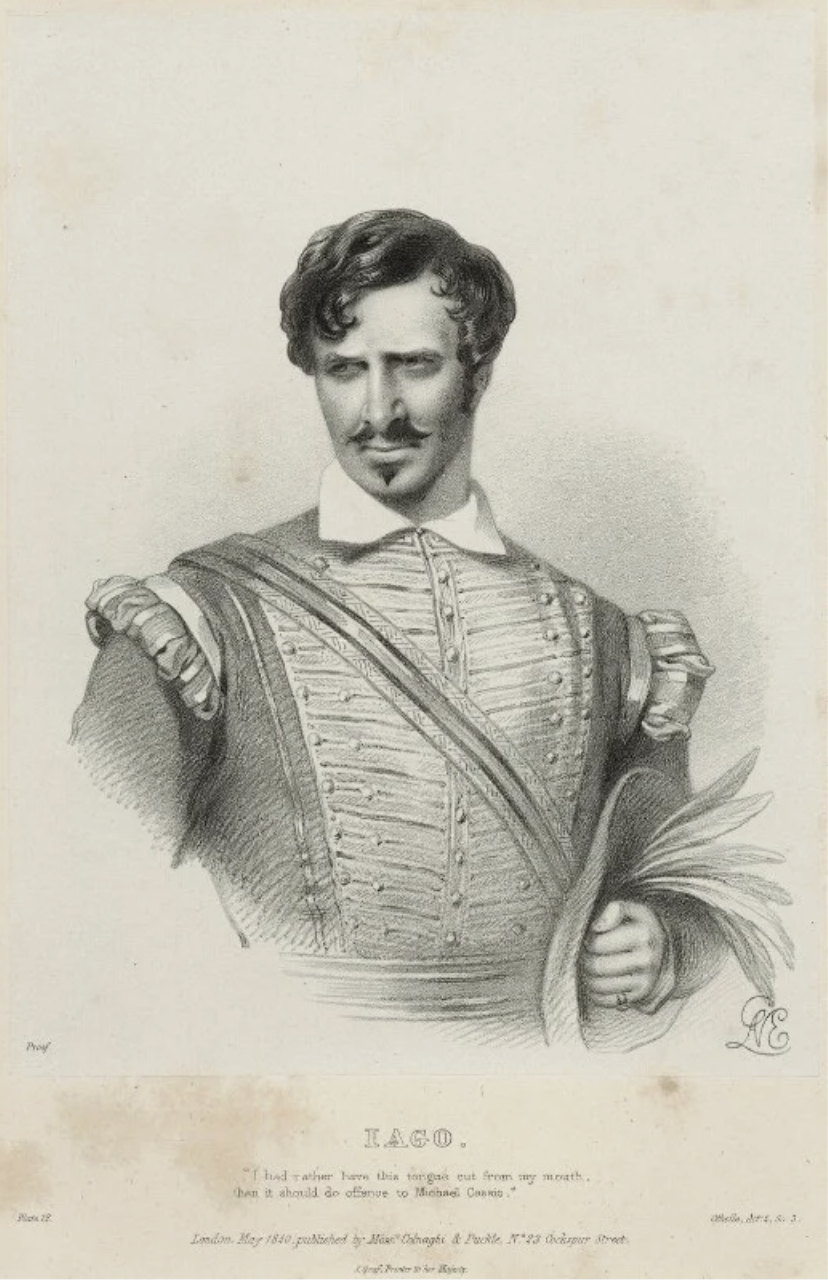
The phrase “done my office” is a deliberately vague euphemism - Iago refuses to clearly state the adultery he is accusing Othello of (ie he suspects Othello of sleeping with Emilia). This reluctance to name the act directly contrasts with how quickly he uses it to justify his anger. His admission “I know not if’t be true” should stop him from taking action, yet he dismisses the lack of evidence entirely. When he says he will act “as if for surety,” he collapses the difference between suspicion and truth, treating a rumour as if it were proven fact. Shakespeare shows Iago creating his own reality and then behaving as though that invented version is unquestionable.
This moment reveals something essential about Iago’s character: his motives are flimsy and self-constructed. He is not responding to a genuine injury but to a story he has chosen to believe because it suits his desire to harm Othello. This helps explain why Shakespeare’s version of Iago is far more disturbing than the villain in the original source text, Cinthio’s Un Capitano Moro. In that novella, the ensign (Iago’s earlier form) has a clear motive - he is in love with Desdemona. Here, Shakespeare removes this motive entirely. By doing so, he creates what critics call a “motiveless malignancy”: a character who does evil not because he is wronged, but because he enjoys manipulating others.
5. ‘The Moor is of a free and open nature… and will as tenderly be led by th’ nose as asses are’
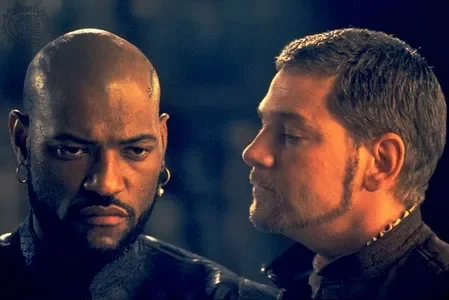
Calling Othello “of a free and open nature” initially seems to acknowledge his generosity and trust, but Iago immediately turns those qualities into vulnerabilities. ‘Free’ suggests independence; ‘open’ suggests honesty, yet Iago frames both of them as weaknesses to be exploited in his vile plan.
The simile comparing Othello to “asses,” (a donkey), typically associated with foolishness and stubbornness insults Othello’s kindness, suggesting that he is a domesticated animal controlled who can be controlled and easily manipulated. This is heightened by the adverb “tenderly,” which suggests Othello will not be dragged, but gently guided into his own destruction, unaware that he is being handled at all.
Shakespeare uses this line to crystallise the central tragic mechanism of the play: Othello’s trusting nature, combined with his outsider status, makes him especially susceptible to manipulation by those who understand and resent his position (ie Iago).
6. ‘Virtue? A fig!… Our bodies are our gardens, to the which our wills are gardeners’
Iago’s dismissive exclamation “Virtue? A fig!” encapsulates his rejection of moral or spiritual constraints. The fig, a small, almost trivial object, becomes a symbol for how little he values ethical considerations as ‘virtue’ is not an intrinsic guiding principle, but a decorative concept used by others to justify their choices.
The extended metaphor of bodies as “gardens” and wills as “gardeners” presents human behaviour as cultivated rather than predetermined. On the surface, this can be read as empowering: individuals supposedly have control over how they shape their own lives. However, Iago’s understanding of “will” includes not just his own, but his ability to influence the wills of others. He sees people as plots of land he can replant, poison, or overrun at will.
Shakespeare uses this metaphor to reveal Iago’s accurate grasp of human psychology which he applies destructively. The garden image also anticipates the way Othello’s mind will be “seeded” with suggestion and allowed to grow wild with jealousy, showing how Iago treats other people’s inner lives as spaces for his own experiments.
7. ‘No, Iago, I’ll see before I doubt’
Othello’s firm declaration reflects his belief in rational judgement and fairness (which is slowly eroded throughout the play). The sequence of verbs “see” before “doubt” creates a logical hierarchy in which evidence precedes suspicion: Othello, as an army general, logically wants to ground his decisions in observable reality, not in any rumour or suggestion.
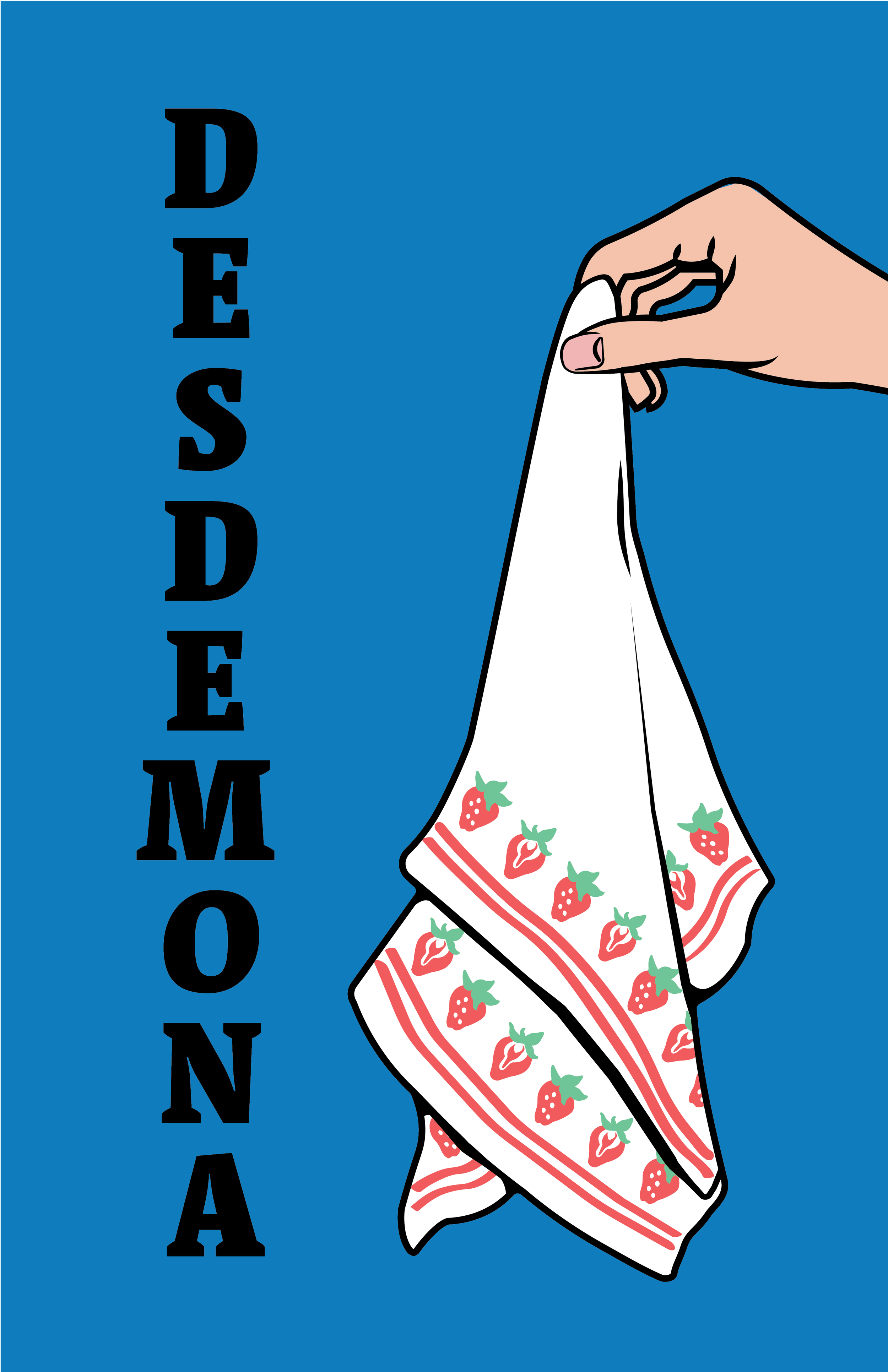
However, the dramatic irony is devastating, as Othello’s reliance on ‘seeing’ becomes a vulnerability as the truth is constantly distored by Iago. His tragic reliance on ‘proof’ means that the distorted ‘evidence’ of the handkerchief and the staged conversations inadvertently grants Iago permission to orchestrate what he will later witness. “Seeing” becomes not an objective act, but one carefully curated by someone with malicious intent (Iago).
Shakespeare uses this line to mark a pivot point in Othello’s character arc. At this moment, he still has the potential to resist Iago’s narrative, yet the very principle that should protect him, the desire for proof, becomes the hinge on which his downfall swings. The tragedy lies in how easily reason can be co-opted when the evidence and truth itself has been contaminated.
8. ‘Beware… of jealousy; it is the green-eyed monster which doth mock the meat it feeds on’
Jealousy is personified as a “green-eyed monster,” the colour “green” traditionally evoking envy and sickness, suggesting that jealousy infects and corrupts the emotional body. Calling it a ‘monster’ externalises the emotion, as if it were an independent beast that seizes control of its host, displacing rational thought.
The phrase “mock the meat it feeds on” suggests that jealousy not only consumes its victim but ridicules them in the process by making them behave in ways that are humiliating and irrational. Iago’s warning, framed as advice, hence operates on two levels: he appears to care for Othello and gains his trust in order to get him to listen to his macchinations, while simultaneously planting a seed of anxiety that will make Othello more receptive to the idea of betrayal.
There is a heavy irony here: Iago is not a neutral observer of jealousy’s effects, but the one deliberately summoning them in Othello. The quote foreshadows the psychological degradation that Othello will undergo as he transitions from dignified leader to someone almost unrecognisable to himself. Jealousy, in this construction, becomes a force that hollows out identity and leaves only the monstrous shell behind.
9. ‘...and I’ll tear her all to pieces’
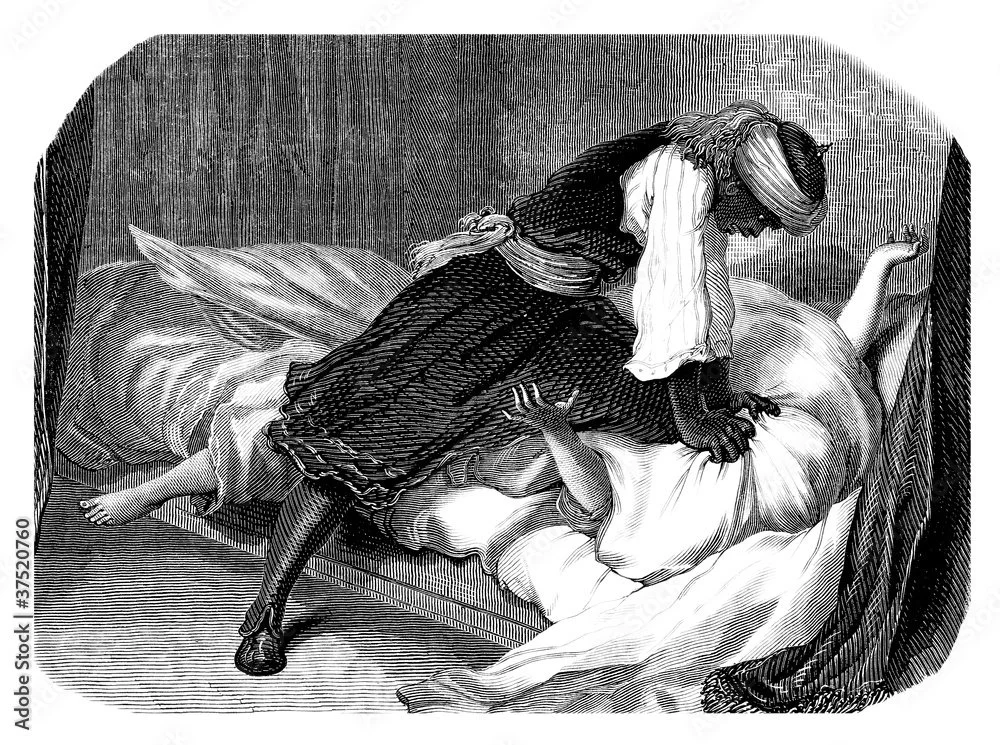
By the time Othello reaches this moment, the controlled, poetic speech of Acts 1 and 2 has given way to a disjointed, violent outburst. The brutal metaphor of “tear her all to pieces” suggests not only literal violence but a desire to dismantle Desdemona’s idealised figure with a total destruction.
Othello’s language no longer flows with the structured dignity of a general, but with the jagged intensity of someone whose inner world has fractured. Shakespeare uses this shift to chart the psychological consequences of sustained manipulation. Othello’s violent language doesn’t emerge in a vacuum; it is the endpoint of Iago’s steady erosion of trust and reality. The man who once valued Desdemona “for the seas’ worth” now envisions her in terms of obliteration, showing how thoroughly jealousy has been allowed to re-script his emotional universe.
10. ‘I kissed thee ere I killed thee; no way but this, / Killing myself, to die upon a kiss.’
The parallel structure of “kissed” and “killed” compresses the entire tragedy into a single, devastating juxtaposition: love and violence are no longer opposing forces but entwined acts. The phrase “no way but this” suggests inevitability, as though Othello perceives his suicide as the only adequate response to the horrible crime he has committed. It reads almost like a self-imposed sentence: he becomes both the judge and executioner of his own downfall.
“Die upon a kiss” fuses tenderness and death, as Othello attempts to restore some form of intimacy and honour in his final act. The kiss echoes their earlier love, yet it is irrevocably tainted by his knowledge of what he has done. In choosing to die in this way, he tries to reclaim agency from the manipulation that led him here, framing his death as an act of self-judgement rather than merely a collapse.
Shakespeare crafts this moment as both resolution and indictment. Othello’s eloquence partially returns, but it now serves to articulate a tragic self-awareness: he understands, too late, how completely he has been deceived and how thoroughly he has betrayed both Desdemona and himself. The line encapsulates the play’s central horror - that a man capable of such love can be turned, through psychological distortion and social pressures, into the instrument of his own ruin.
Looking for some extra help with your Othello essay?
We’ve got an incredible team of English tutors at Pinnacle Learners!
If you’re studying Othello for Module A or B, we’ll help you strengthen your essay writing and build the confidence to ace your next assessment.
Our one-on-one lessons are available online or in person at our office in Rozelle, giving students across Sydney’s Inner West (Balmain, Leichhardt and beyond) the support they need to excel.
Over the years, our students have boosted their results by 20% or more in just 6 weeks through expert guidance, proven strategies, and mentoring that goes beyond the textbook. If you’re looking for support that builds real understanding and lasting skills, we’d love to help.
